Saved the best for last:

I really liked this course, and as I told you (Serdar) in the beginning I’m recommending it to my friends who study here at KTH. In general, as said before, I really like the layout of the course and I would prefer if more courses were hands on like this one. I really enjoyed the guest lectures, and I thought it was brilliant to take in people of experience on each topic of the course. Of course not all of them were perfect, but I liked how hard you judged the guest speakers and that you spoke your mind after the Sandbox presentation.

I know that you wanted us to get out of our comfort zone and get up off our asses in this course. This I also liked, because you should push yourself to do new things every day. Nevertheless, maybe for the future, this part should have a set deadline, so procrastinators, like myself, do not end up doing them at the last possible minute. Even so, I really liked going to the events, and to be honest I wouldn’t have gone to these if I didn’t have to. And perhaps I’ll go again, especially to Sup46, I got a lot of great connections and I think just going there could lead to something great.

In a way, I also liked that we didn’t get all the information right at the start of the course. Sure, it got a bit stressful sometimes, but it also taught me more about real life issues involved in a venture project. Everything else in this school is so structured, and if you want to work with a venture, it really isn’t. This made me think more critically and therefore I also enjoyed Serdars emphasize on us having to believing in our own opinion.

Even so, I have some suggestions of improvement: I have tried to use Linkedin more and more, but still I missed a lot of course information because (in my opinion) Linkedin has restrictions, such as notifications. Therefore, I would have preferred information being put up on some other site. I cannot really think of a site of my head, as bilda neither is the best. A possible solution could be a Facebook group as this course is so dynamic, but I am not sure that this would agree with everyone.

This course has thought me a lot, probably more than the rest of my courses here at KTH combined, because now I know I want to pursue my dream of becoming an entrepreneur!

Thank you Serdar!
Hey again guys!

Yesterday I tried Spontano, a Startup from Stockholm, created to be the interphase between customers and events. I got in contact with the company’s founder Ludvig Linse through email. The venture itself is a platform/marketplace for events that haven’t been sold out and therefore have tickets left, which are then offered on the platform for a better price. Like any type of last minute booking sites its target audience is spontaneous, hence the name Spontano. The Website itself targets mostly young active people, therefore the founder was excited to try his new ideas and interphase on me. First we got to try a different website layout, and gave him so pointers why it was good and what was less good.
After this I tried Ludvigs own website which was different in many ways. He wanted me to give him feedback of the customer experience. So what I did was more or less playing around with his sight for 20 minutes and went through all the steps.

And I was impressed. I myself have worked with startups trying to create good working websites, and it always sounds easier than it is. There are always things that the creators haven’t thought about because they are too close to the creation themselves, but in this case I was not able to find any big glitches. It is impressive to have created this in such a short time and I believe that this venture could be very successful if they get its product out there even more.

After trying this I contacted an acquaintance of mine. Who I remembered had created something similar. I did the same for my friend as for Ludvig, I tried his venture as well. It is very similar to Spontano in many ways. That is why it got me thinking of it as I reviewing Spontanos website. It is called Heyeventand it is a platform for events in general. It connects all Facebooks events and enables you to easily find those close to your location. This Startup is the same age as Spontano, but instead the founder, Jonatan Heyman has gotten a lot of traction abroad. The Startup is really successful.

This is also obvious in the customer interaction on the site. You notice right away that the person that wrote the code behind the sight has worked on venture projects before and has created many websites. Here as well, I could not really be of that much of help as I had hoped in the beginning, as the products themselves were already so good. The layout is very modern. The only negative feedback I gave was that the website was a bit to crowed. That it is similar to the new Facebook, too much happening, advertisements everywhere. This compared to a favorite of mine, apples website. I know they cannot reach this completely as Jonatan has a very different product. Nevertheless, I said that he had consider changing the layout a bit earlier and therefore though my feedback on the matter was interesting.

I gave Jonatan as well as Ludvig the feedback about signing up with Facebook. This is just a laze man’s way to solve a coding/interaction problem. I am not a fan of signing up with Facebook, because it only empowers Facebook, no one else earns money or gains anything form this. And it creates a deeper, ‘Big Brother sees you’ issue. All the information that these two sites and many more, give to Facebook is then stored and sold. Nevertheless, I know that many of their customers are lazy and like this feature. So therefore I also understand why their websites carry the feature.

Something that struck me is that both this websites are into delivering events. Spontano those it towards a niche market and HeyEvent towards a broader mass market. It might be beneficial for them both to meet up and discuss merging. I believe this would probably be hard to convince them to do as they have worked alone with their projects, their ‘babies’. Nevertheless, they aren’t really competitors. Hence a merger could empower them both in a growing new market.

https://www.spontano.se/tour

http://heyevent.com/

Hey guys!

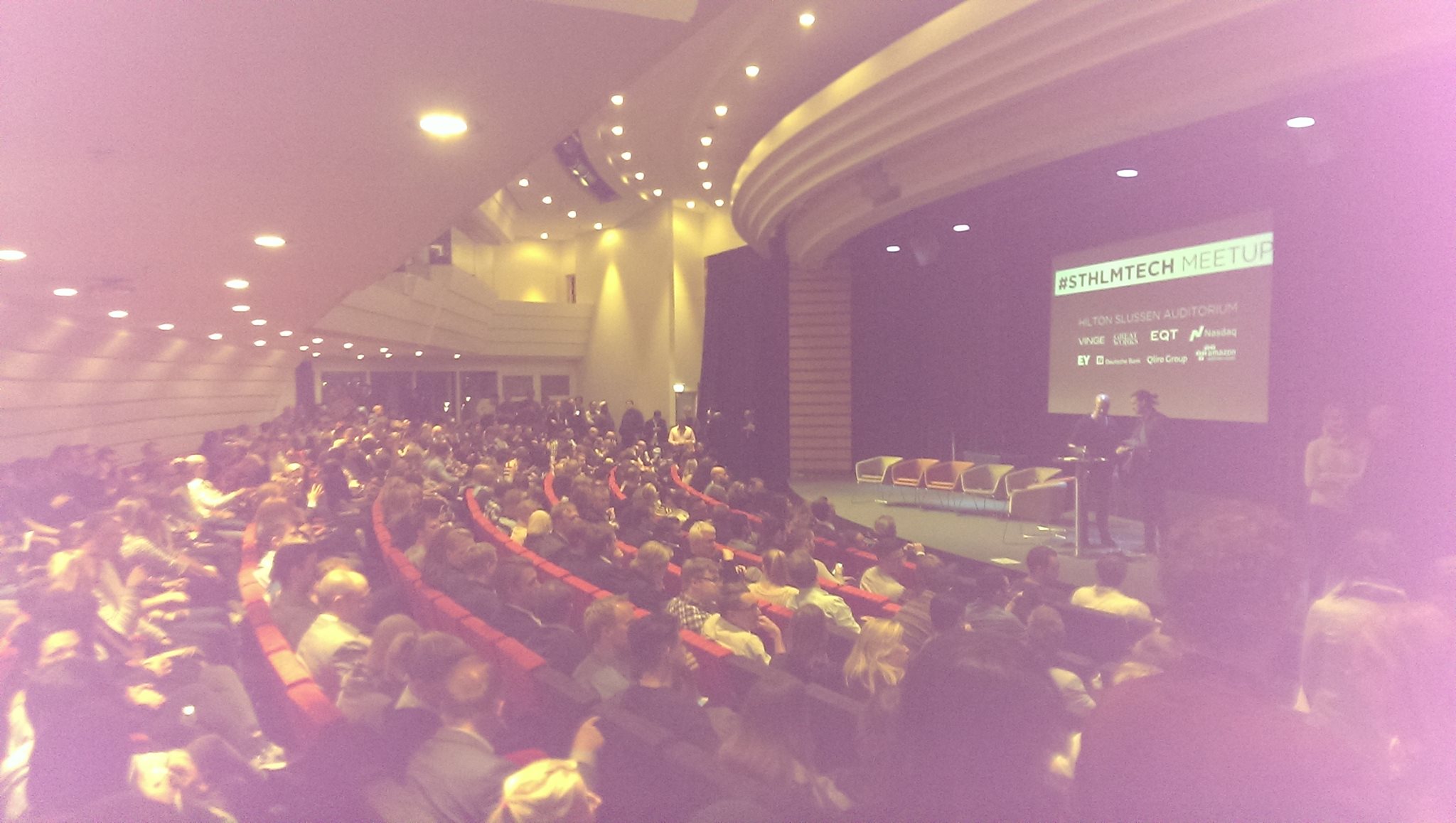
Last week I went to sthlm tech and forgot to write about, hence I write it now instead. As Tim said and most of you already know it was at Hilton Hotel at slussen, so it was close to my house and comfortable. I was there early and was able to get a seat, which was very nice, because it got really crowded and some people, including some class mates had to stand by the side. It was nice to see that many people there and I can understand why, because the whole presentation was really interesting.

In the beginning presented all the big tech-investments made this week, they presented some founders and what they had created. Everything was very up to date, and it felt like being in a room where stuff actually happen, with people that push boundaries every day.

A big part of the presentation later on focused on the refugee problem that is occurring all over Europe at the moment and especially how the tech-society can help. I right away got to thinking about Sophie Lööbs idea that she presented in class during the elevator pitches. The one with the app, that gets companies in contact with refugees that specific skill set. I also read a couple a weeks ago about an effort made by the government to lower the unemployment rate. To do this they were going to invest 1,3 billion SEK, if I am not mistaken. Might be a side not I realized already during the presentation, and that those kind of innovations are not really what they are search for perhaps, but still interesting way to solve a problem that is out there.

I liked the app which was presented during this part, called “Welcome”. The idea was simple in itself, giving the user information within the app on Sweden and how things work here more or less. Even so, I saw a clear limitation with it; that you need to own a smart phone as you arrive. I don’t exactly how many bring their phones, but I imagine few refugees come here with smart phones. Still though, the main idea of the app is beautiful and I liked the part where refugees could get in contact with local Swedish people. Nevertheless, I believe it is going to be hard to get a big amount of people to use the app without gaining anything, sadly, few people volunteer to do this type of things.

The second part dealing with the refugee problem was a bit simpler. A company, similar to the Sandbox, holds a kind of Hackathon where the purpose and theme is to help refugees. I like the idea of Hackathons, I do not believe they always create direct results, even so they do always create indirect results; in contacting ambitious, driven people. So maybe they won’t solve all the issues right away, but I believe they will create a domino effect.

Later on, international investors presented how different their ‘Startup-atmosphere’ is back home and this got me thinking of what Serdar said in the being of the course. That it is always important, if not essential, to have local knowledge, having local partners that know the culture. Because, as they presented here, most of their ways of seeing or solving problems where alien to me.

The last part, as Tim wrote last week, was a bit unorthodox. I did not really agree with the investors and thought they behaved unprofessional. Nevertheless, this is how the world works, sometimes you pitch an idea and get laughed at, and it might be hard put I believe this guy, who came up on stage and went through this still trying to keep strong, will succeed if he dusts himself of and continue afterwards. It is as the question on the exam;” who should you believe?” in yourself.

12169524_1064421963568941_102842914_o

Two days until the exam, and I’m still a bit confused on what material we should emphasis on while studying. I know Serdar has said we should answer the question handed out a couple of weeks ago and focus on the guest lectures. But as you all know there are only a few guest-lecture-slides up online. Does anyone have any good notes from the guest lectures or any other tips on what to study on? And did anyone take any notes during the class-discussions?

Hey everyone!

Yesterday I went to Sup46 mingel event. Right away I met my whole project group and some other classmates. Even so, I got talking with some really interesting people. Ivan presented me to Nikhil from India. We got talking about his Startup back home. He has created tech-labs open for the public and his startup is very successful. We got talking about different opportunities and ended up deciding to meet up some time soon to try to create an innovation.

IMG_4306

Sorry about the picture. Maybe someone can comment an tell me how to rotate it, when I try to do it just say “load media again”.

I was a bit confused this Friday because I thought the lecture would focus more on the venture project. I have a hard time figuring out what it is concerning and what is expected of  us. I have talked to some people in class and I have gotten similar responses and concerns. Then I started to think, maybe this is the point. Perhaps Serdar wants us to figure it out ourselves or as a group, to simulate a real life scenario of creating a startup? Because it is always hard to know what to do next when creating a startup.

I was intrigued when watching Eric Ries video on YouTube “The Lean Startup”. I have never before heard or thought about the possibility of creating a science of entrepreneurship, and how he compered a startup to an experiment was an interesting new way of looking at it. The resemblance between this two is staggering. To me it has always been this way, when trying to create an idea or developing others ideas. So after he pointed out in the video how you can think about a startup, I have not been able to can get it of my mind.


Each time I have tried to startup a company it has been an experiment in most ways, and I have never been able to predict the outcome, even though I have head most of the information at hand. This is why I agreed that it must be smarter to be more adaptive early on in the process, because as it is for an experiment it gets harder to do “The Pivot” the further on you have come.


Someone in class mentioned early on in the course of a Ted video, “The single biggest reason why startups succeed” by Bill Gross. In this video the conclusion of Bill Gross talk is that timing is the most important aspect of a startup. Even though he had several other aspects of a startup that you would have thought would have a more significant effect of the outcome of the startup in his research, such as the idea itself.


What I find interesting with both of these videos is that they have more or less similar thoughts on how startups could be better; It does not matter if you have a brilliant team or idea, if you can not adapt to your ever changing surroundings, and use it to your advantage.


Eric Ries talk, “The Lean Startup”

https://www.youtube.com/watch?v=fEvKo90qBns


Bill Gross talk, “The single biggest reason why startups succeed”

https://www.ted.com/talks/bill_gross_the_single_biggest_reason_why_startups_succeed?language=en